

Most attic rat jobs fail for the same reason. The homeowner solves the wrong half of the problem. Killing rats is the easy part. Keeping them out is the part that takes craft, and the 2026 playbook looks different from what worked five years ago.
California has tightened rodenticide laws. Exclusion materials have improved. Smart monitoring has changed how we catch infestations early.
Key Takeaways
- Why killing rats is the easy part, and what most homeowners get wrong about the half that actually keeps them out
- How to tell a roof rat from a Norway rat at a glance, and why species identification changes everything that follows
- The five-move sequence that clears an attic infestation, plus the one wrong step that turns a small problem into a wall full of dead rats
- Which 2026 California laws took DIY poison off the table, and what licensed pros use now
- The six mistakes that bring rats back even after the colony seems gone
- The four signs that mean DIY is no longer enough, and how to vet a pro when you call one
Identify the Species Before You Touch Anything
Before you set a single trap, identify the tenant.
Roof rats are by far the most common attic invader in LA. Slender, dark, and agile, they travel along power lines and tree branches, leave spindle-shaped droppings around 12 mm long, and prefer high spaces.
Norway rats are heavier, brown, and ground-dwelling. You’ll find them in crawl spaces and garages, not attics. If they’re up high, something unusual is going on.

Worth ruling out: squirrels make daytime noise and louder thumps. Raccoons sound like a small adult walking around. Opossums hiss. Attic rats are nocturnal, so daytime sounds usually mean the colony has outgrown its space.
Reliable signs of an active infestation:
- Greasy rub marks on rafters where rats squeeze through tight spots
- Flattened “runways” through blown-in insulation
- Shredded paper or fiberglass piled in corners
- A sharp ammonia smell that gets stronger near nests
If you see two or more of these, you have an active colony, not a one-off visitor.
Why Waiting on Attic Rats Costs More Than Acting?
Two real problems come with attic rats – disease risk and property damage.
The rats infection risk is the part most homeowners underestimate. Hantavirus, leptospirosis, salmonellosis, and rat-bite fever all transmit through dust, droppings, urine, or bites. HVAC ducts running through an infested attic push that contaminated air through the rest of the house.
Rat dander is also a documented asthma trigger, which hits kids, the elderly, and pets hardest.
The property side gets expensive fast. Chewed wiring is a documented fire risk – gnawed insulation around live conductors is how rodent-related electrical fires start. Heavily soiled insulation loses much of its R-value, so your AC works harder and your utility bills climb.
The math gets worse the longer you wait. A single female roof rat can produce 30+ offspring per year.
Five Steps to Get Rid of Rats in Attic Spaces
Order matters here. Skipping a step or doing them out of sequence is why most DIY attempts fail.
- Inspect from the outside in
Walk the exterior first – roofline, soffits, dormers, eave returns, plumbing vents, AC chases. An adult roof rat needs about half an inch to squeeze through; juveniles need a quarter. Anything wider than ¼ inch should be treated as a doorway and sealed.
Then go into the attic with a UV flashlight and trace urine streaks. They’ll lead you back to entry points you missed outside.
- Trap before you seal
Always. Sealing first locks rats inside your house and creates a much worse problem. Dead rats in wall voids can take weeks to stop smelling.
Snap traps remain the most reliable tool. Place them perpendicular to rafters and along droppings trails, not out in open space. Bait with peanut butter pressed with a few oats or a smear of bacon grease. Check daily, reset, and move locations every few days.
- Seal with the right materials
Use ¼-inch galvanized hardware cloth, copper mesh, and sheet-metal flashing. Screw it in place and seal it tight. Loose-stuffing into a gap will not hold. Spray foam alone is useless; rats chew through it in minutes.
Then move on to vent screens, chimney caps, door sweeps, and tile-roof closures.
- Decontaminate without making it worse
This is where DIY usually gets dangerous. Dry sweeping droppings aerosolizes pathogens. That is exactly how rat infection reaches humans.
Wear an N95 respirator and gloves. Mist droppings and nest material with an enzymatic cleaner before touching them. Double-bag everything. Replace heavily soiled insulation; cleaning it is not worth the effort.
- Monitor for 60–90 days
This is the step most homeowners skip, and most pros include. Smart bait stations at the perimeter or a weekly attic walk-through catch reinfestation early. If new rats are going to find their way back in, they’ll do it in the first three months.

What’s New in 2026 for LA Homeowners?
The rules around rodent control have moved.
California’s rodenticide laws keep tightening. Second-generation anticoagulant rodenticides (SGARs) were banned for most uses under AB 1788 in 2020, and AB 2552 (effective January 1, 2025) extended those restrictions to chlorophacinone and warfarin. Licensed pros now lean on integrated pest management, meaning trapping, exclusion, and sanitation, with poison as a last resort. Good news for pets and wildlife. It also means DIY poison-and-pray is off the table.
Smart monitoring goes mainstream. Wi-Fi-enabled traps notify the operator the moment they fire. We’re resolving infestations in days, not weeks.
Better exclusion materials. Stainless steel rodent mesh, polymer-coated chew barriers, and rodent-rated expanding sealants are now widely available, and they actually hold up.
Thermal imaging. A handheld thermal camera finds active wall-void nests in minutes without anyone cutting drywall.
Why Rats Return After You Think the Job’s Done?
Reinfestation stories tend to share the same handful of causes. The biggest is setting too few traps. Two or three will not shut down an active colony, so plan for one trap every few feet along active runways and double up near droppings clusters. Treating only the attic is the next one. In most LA homes, joist bays and utility chases link the attic to the garage and crawl space, so if you seal one zone and skip the others, the rats just move down a floor. Ignoring the roof is the third common error, since the majority of LA attic rats enter from above. Check gutter joints, tile gaps, and ridge vents before anything else.
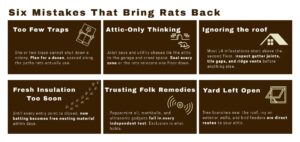
The remaining three are easier to spot once you know what to look for. Replacing insulation before exclusion is finished turns new insulation into new bedding. Peppermint oil, mothballs, and ultrasonic devices do not hold up to independent testing regardless of what the marketing claims. And skipping the yard leaves rats with highway access to the roof. Branches within four feet of the house, ivy climbing exterior walls, and bird feeders all bring them right to the building.
Address all six, and you’ll stop rats at the point of entry, not chase them indoors month after month.
When to Stop Rats Yourself and When to Call a Pro?
DIY works for a handful of rats and a tight, well-sealed house. Otherwise, you need help.
Call a professional if:
- You hear activity after two weeks of consistent trapping
- Droppings show up in new rooms or below the attic
- Insulation is visibly soiled across large patches, not isolated spots
- You smell decomposition inside a wall
A proper service should include a full exterior exclusion map, a written trapping plan, attic decontamination, and a re-entry warranty. If the quote skips any of those, get a second opinion.
The One Point to Remember
The most expensive mistake with attic rats is waiting. A two-rat problem caught early costs a few hundred dollars in traps, mesh, and a Saturday afternoon. The same problem six months later, once the colony has soiled the insulation and chewed through wiring, runs into four figures.
Document everything as you go. Photos of droppings, entry points, and damaged areas save time if you bring in a pro, and they are the only record you will have if related damage (an electrical fire, a water leak from a chewed line) ever lands on an insurance claim.
If you want it handled in one pass, 360 Rodent Control covers attic rat removal, rodent proofing, and decontamination across Los Angeles.
FAQ
1. Will my homeowner’s insurance cover the damage?
Usually no. Most policies exclude “vermin damage” outright. A sudden related event, like an electrical fire from chewed wiring, may be covered. Read your policy or ask your agent.
2. Do I have to replace all the attic insulation?
Only the contaminated portions. Reputable companies don’t push full reinstalls when spot remediation will do the job.
3. Is it safe to store things in the attic after rat removal?
Yes, once it’s decontaminated and sealed. Use plastic bins, not cardboard. Cardboard becomes nest material the moment any rat finds its way back in.
4. My neighbor has rats. Will mine come back?
Possibly, which is why exclusion matters more than killing. A properly sealed house stays a closed door regardless of what’s happening next door.
5. Do I have to leave during treatment?
For trapping and exclusion, no. For heavy decontamination or fogging, plan to be out for a few hours.
6. How do I know the rats are actually gone?
No new droppings, no fresh gnaw marks, and 14 consecutive quiet nights post-trapping. That’s the benchmark we use.
