

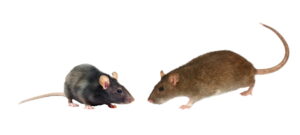
Most failed rat treatments in Los Angeles come down to one mistake. The wrong species got targeted. Norway rats and roof rats both live across Southern California, but they nest at different heights, eat different foods, and enter buildings through completely different openings. Mix them up, and your traps sit empty, your sealed gaps don’t match real entry points, and the colony keeps breeding behind your walls.
What you’ll learn:
- The one body proportion that separates the two species faster than fur color is
- Why the sounds you hear at 2 AM already tell you which rat is nesting
- What droppings reveal when you never spot the rat itself
- How LA’s tree canopy and sewer grid each favor a different species
- The difference in the cleanup between an attic colony and a crawl space colony
Wrong Species, Wrong Plan (What Misidentification Costs You)
Roof rats and Norway rats enter buildings at different heights and nest in different zones. Confuse the two, and the treatment targets the wrong part of the structure.
A technician working from the wrong ID will set traps where the target species doesn’t travel, seal openings it never used, and skip the actual nesting zone entirely. The result is callbacks, a colony that keeps growing, and contamination spreading into new sections of the home.
This is why any rat control plan has to start with the right species ID. Rodent-proofing built around the correct species works in weeks, while proofing built around the wrong one drags on for months.
The Tail Test and Three Other Field Markers
You don’t need to catch a rat to identify it. You need one clear look, even at a distance.
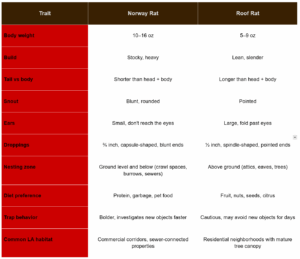
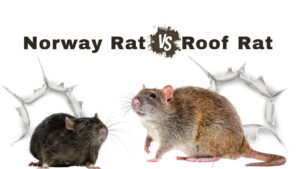
Start with the tail. A roof rat’s tail is longer than its head and body combined. A Norway rat’s tail falls short of that mark. At 15 feet in low light, tail-to-body proportion is easier to read than fur color.
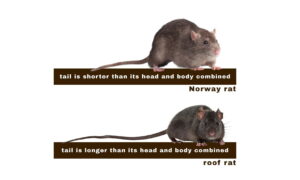
Body size confirms it. Norway rats weigh 10–16 ounces and carry a thick, heavy build. Roof rats weigh 5–9 ounces and look lean by comparison.
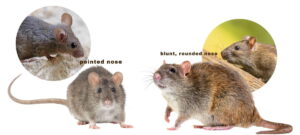
Snout shape helps when you get a closer view. Norway rats have a blunt, rounded nose. Roof rats have a pointed one. Ear size tracks the same split. Roof rat ears are large relative to the skull and fold forward past the eyes. Norway rat ears sit smaller and tighter against the head.
Don’t rely on color. Both species range through grays and browns. The common names brown rat (Norway) and black rat (roof) are misleading. Plenty of roof rats are brown, and plenty of Norway rats are dark gray.
Norway Rat vs Roof Rat at a Glance
Droppings, Sounds, and Grease Marks Tell You the Species
Most LA homeowners never see the rat. They find droppings, hear scratching, or spot grease streaks. That physical evidence is enough for accurate roof rat identification or to confirm Norway rat activity.
Droppings
Norway rat pellets are capsule-shaped with blunt ends, roughly ¾ inch long. Roof rat droppings are spindle-shaped with pointed tips, closer to ½ inch. Shape matters, but so does location. Pellets along attic joists or on top of stored boxes point to roof rats. Pellets along baseboards, behind appliances, or near floor drains point to Norway rats.
Sound location
Scratching and scurrying above the ceiling at night means roof rats. The same sounds inside walls at ground level or beneath the floor mean Norway rats. Both species are nocturnal, so the noises show up between midnight and 4 AM.
Grease marks
Rats leave dark, oily streaks along repeated travel paths where their fur contacts a surface. Look for those streaks on rafters and overhead beams for roof rats, or along baseboards and pipe chases for Norway rats.
Where Each Species Nests in a Typical LA Property?
Map both species onto a standard LA single-family home, and the vertical split becomes obvious.
Roof rats nest in attic insulation, inside eave cavities, and up in the crowns of untrimmed palm trees. They travel along overhead utility lines between properties and use citrus and avocado branches as on-ramps to the roof. Any gap wider than ½ inch at the roofline, a damaged vent screen, or an open eave return is a way in.
Norway rats stay at grade or below. They burrow along the base of exterior walls, nest inside crawl spaces, and travel through underground sewer lines. Older LA homes with cracked sub-floor vents or deteriorating plumbing connections are high-risk for Norway rat activity.
Both species can share the same property at the same time, divided by floor. That split holds as long as food stays abundant on the block.
Why Roof Rats Dominate LA Neighborhoods (and Where Norway Rats Show Up)?
LA’s residential zones are roof rat territory, and the reasons are climatic and structural.
- Southern California never gets cold enough for a winter die-off. Roof rat colonies breed year-round, and the dense fruit-tree canopy across most neighborhoods gives them food and shelter 12 months out of the year. Older single-family homes with deferred roof maintenance keep delivering new access gaps every season.
- Norway rats in Los Angeles hold ground in different environments. They concentrate around commercial strips with open dumpsters, properties tied into aging storm drains, ground-floor restaurants, and multi-unit buildings with subterranean parking or below-grade storage.
When both rat species in LA share a block and food runs short, Norway rats win the competition. They’re heavier, bolder around new objects, and reproduce faster. Norway rat litters run 6 to 12 pups compared to 5 to 8 for roof rats, and both species reach breeding age in about 8 to 12 weeks. That reproductive edge is how Norway rats displaced roof rats across most of the northern United States after arriving on trade ships in the 1700s.
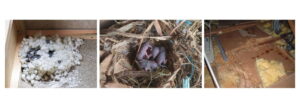
Attic Colony vs. Crawl Space Colony (How Cleanup Changes by Species)
The species ID determines where the contamination sits, and that drives the entire cleanup scope.
A roof rat infestation concentrates damage in attic insulation, HVAC ducting, and above-ceiling drywall. Urine-soaked insulation loses R-value and becomes a reservoir for airborne pathogens. Droppings accumulate along joist runs and around HVAC plenums.
A Norway rat colony does parallel damage below the living space. Crawl space vapor barriers get shredded. Sub-floor insulation gets pulled apart for nesting material. Sewer pipe junctions collect droppings and urine in spaces with poor ventilation.
The decontamination plan, PPE requirements, and insulation replacement scope all depend on which zone the colony occupied. A rat removal job that treats the attic when the colony lived in the crawl space leaves the real contamination untouched.
Get the Species Identified on the First Visit
If you’re finding droppings you can’t match, or hearing sounds you can’t place, a trained technician can confirm the species in a single inspection and map every entry point that needs sealing. For rat removal that targets the right species from day one, call 360 Rodent Control at (818) 853-2882 or book an inspection online.
FAQ
1. Do Norway rats come up through toilets?
They can. Norway rats travel through sewer lines and are strong swimmers. They can surface through floor drains and broken toilet seals. Roof rats don’t use sewer pathways. If the activity traces back to your plumbing, you’re dealing with Norway rats.
2. Do I need different traps for roof rats and Norway rats?
The same trap type works for both. Snap traps are the standard. The difference is placement. For roof rats, set traps on rafters, fence rails, and elevated ledges where they travel. For Norway rats, set traps flush against walls at floor level, near burrow openings, or along pipe runs. A trap placed at the wrong height for the species will sit untouched.
3. Can I use the same bait for both species?
You can, but results improve when you match the bait to the species’ diet. Roof rats respond better to dried fruit, nut butter, or citrus. Norway rats go for protein, like bacon, pet food, or canned sardines.
4. Does California’s rodenticide law apply differently to each species?
No. AB 1788 restricts second-generation anticoagulant rodenticides for all commensal rodents, not just one species. Exclusion and trapping have no legal restrictions, which is one reason an exclusion-first rat control plan works for both roof rats and Norway rats.
5. Will getting rid of one species cause the other to move in?
It can. Removing Norway rats from a property with nearby roof rat populations may open ground-level nesting space for roof rats to expand into. A full exclusion job that seals gaps at every height prevents this swap.
6. How quickly can a misidentified infestation grow?
Fast. A single female Norway rat can produce 40 to 80 offspring in a year. Roof rats are slightly slower but still capable of 20 to 40 pups annually. Every week spent trapping at the wrong height or sealing the wrong openings is a week the colony keeps expanding.
