

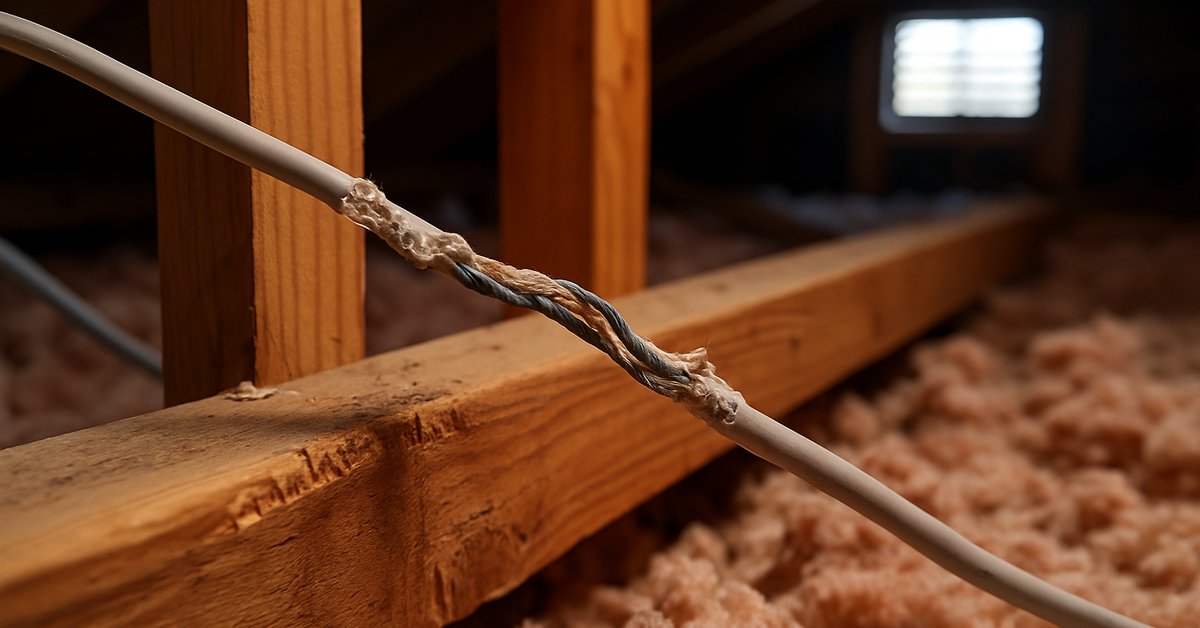
Roof rats across Orange County are taking over local homes, and the problem is getting worse every season. Full rodent proofing typically costs $1,200–$2,800 in Orange County, with attic cleaning and re-insulation adding another $1,800–$4,500 on top. Orange County’s labor market runs higher than the Inland Empire, so expect to pay a modest premium over neighboring regions. This guide covers why infestations are worsening, what entry points look like on typical OC homes, real cost data broken down by service tier, and how to pick a licensed contractor who will actually solve the problem long-term.
Before you hire anyone, get a free estimate from a licensed Orange County rodent proofing specialist so you know exactly what you’re dealing with.
Why Is Orange County Overrun With Roof Rats Right Now?
Roof rats in Orange County have reached near-epidemic levels, and it’s not because homes are dirty. Rattus rattus, the black rat, is a tree-dwelling species that thrives specifically in warm climates with dense overhead canopy — which describes most of Orange County perfectly. The region’s Mediterranean climate means mild winters with almost no hard freezes, so rat populations don’t get the annual die-off that colder climates see. Breeding cycles run year-round here.
In the Woodbridge neighborhood of Irvine, mature trees and interconnected greenbelts create literal highways for roof rats moving between homes. Anaheim Hills has a similar problem: the hillside terrain, established oak and eucalyptus canopy, and large lot sizes give rat colonies room to grow before homeowners even notice. These aren’t dirty neighborhoods. They’re just structurally ideal for Rattus rattus.
Older parts of Santa Ana and Fullerton add another layer. Housing stock from the 1950s through 1970s has decades of wood shrinkage, fascia deterioration, and soffit gaps that modern construction doesn’t have. A gap as small as half an inch is all a roof rat needs to get inside. And because these neighborhoods are denser, infestations spread faster from property to property.
Honestly, roof rats don’t discriminate by income or cleanliness. A well-maintained home with one overhanging avocado tree and a 40-year-old fascia board is more vulnerable than a neglected property with no tree cover. That’s a fact most pest control companies won’t lead with, but it’s true.
How Do Roof Rats Get Into Orange County Homes?
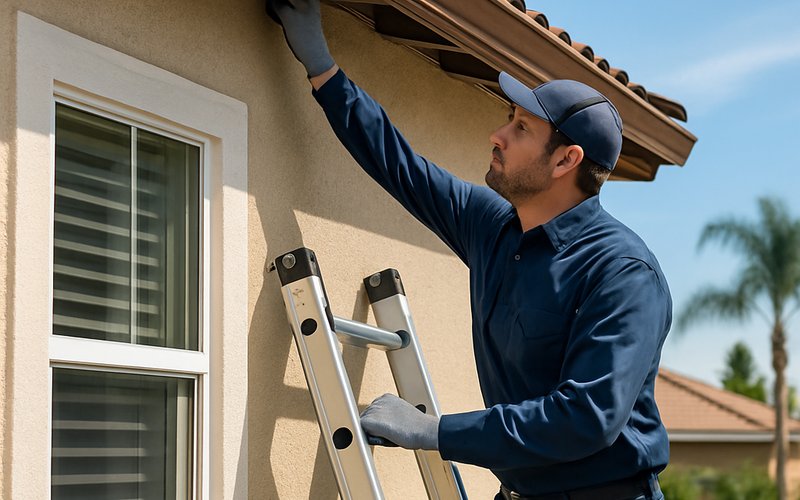
The entry points on Orange County homes are predictable once you know what to look for. Most infestations follow the same path: a rat uses an overhanging tree branch or utility line to reach the roofline, then exploits a gap in the tile, a deteriorated soffit, or an unscreened attic vent to get inside.
The Tree-to-Roof Pipeline
Yorba Linda and Tustin are two cities where this pattern is almost universal. Both have mature citrus and avocado trees — common residential plantings in OC — that frequently grow close enough to touch rooflines. A lemon tree with a branch within 18 inches of the roof is essentially a welcome mat. One homeowner in Anaheim Hills traced their entire infestation to a single overhanging lemon tree whose branches were brushing the roofline. Once that branch was trimmed and the gnaw point sealed, the activity stopped within two weeks.
Tile Roofs and Soffit Breaches
Tile roofs, which dominate Orange County housing, have a specific vulnerability: the open ends of barrel tiles at the eave line. Rats slip directly into the roof cavity through these openings with no gnawing required. From there, they move into the attic through soffit breaches or gaps around plumbing and electrical penetrations. On 1960s and 1970s tract homes, the original wood fascia boards have often softened or separated enough to create exclusion gaps that weren’t there when the house was built. Utility lines are another common bridge — rats can run along power lines and drop directly onto a roof.
Trade terms worth knowing: a gnaw point is any spot where a rat has chewed through a hard surface to create or enlarge an opening. An exclusion gap is any structural gap rats can exploit without chewing. Soffit breaches are openings or separations in the horizontal underside of the roof overhang. A qualified rodent proofer will identify all three during a thorough inspection.
What Does Roof Rat Damage Actually Look Like in Your Orange County Home?
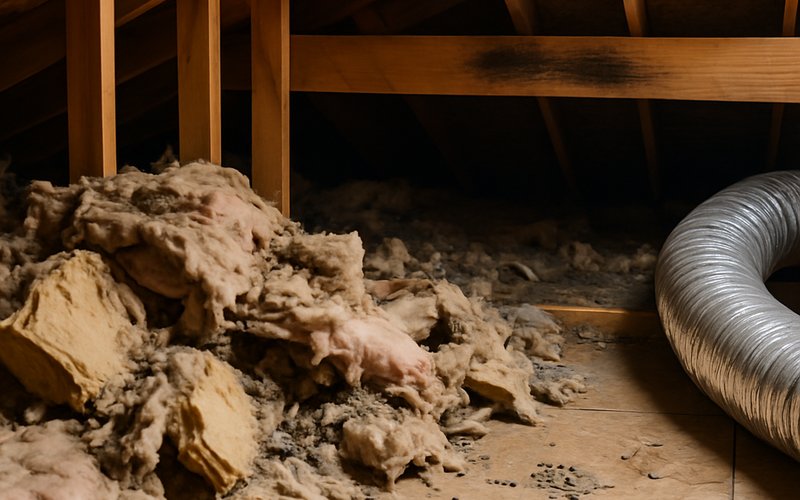
Roof rat damage is distinctive once you know the signs. The most dangerous damage you’ll find is gnawed electrical wiring in the attic. Rats chew insulation off wires, which creates a real fire hazard — and it’s one of the most common causes of attic electrical fires in older Orange County homes. This is not an exaggeration. Insurance adjusters and fire investigators see it regularly.
In the attic itself, you’ll find contaminated insulation matted down from rat activity, soaked with urine, and riddled with droppings. Roof rat droppings are spindle-shaped, about half an inch long, with pointed ends — different from the rounded droppings of house mice. You may also notice grease trails along rafters and wall plates, dark smear marks left by the oils in rat fur as they travel the same routes repeatedly.
This is where attic cleaning and re-insulation becomes relevant. Contaminated insulation can’t just be fluffed back up. It needs to be removed, the attic space sanitized, and new insulation installed. A before/after attic insulation replacement is one of the most dramatic improvements you can make to both air quality and energy efficiency in an affected OC home. Crawl spaces under older homes can suffer similar contamination and benefit from professional crawl space cleaning in Orange County as part of the same project.
Don’t ignore the signs or wait for things to get worse. The longer a colony is active, the more extensive the insulation damage and the higher the remediation cost.
How Much Does Roof Rat Extermination Cost in Orange County?

Cost ranges in Orange County are specific enough to plan around, even before you get a quote. Here’s what the local market actually looks like right now.
| Service Tier | What’s Included | Typical OC Cost Range | How Long Results Last |
|---|---|---|---|
| Inspection Only | Full property assessment, entry point report | $75–$150 | N/A (diagnostic) |
| Trapping and Removal | Trap placement, monitoring visits, removal | $350–$650 | 3–6 months without exclusion |
| Full Rodent Proofing | Trapping plus all exclusion and sealing work | $1,200–$2,800 | 2–5 years or longer with maintenance |
| Attic Cleaning and Re-Insulation | Contaminated insulation removal, sanitizing, new insulation | $1,800–$4,500 | Permanent (one-time remediation) |
| Full Package (Proofing + Attic) | All of the above combined | $3,000–$6,500 | Long-term with periodic checks |
Orange County labor rates run roughly 15–25% higher than the Inland Empire for the same scope of work. That’s the reality of doing business in OC. A full rodent proofing job that might cost $1,000 in Riverside could easily run $1,400 here. That said, the quality of licensed contractors in the county is generally solid, and the premium is usually worth it for work that’s guaranteed.
Your biggest cost driver is attic square footage and the severity of insulation contamination. A 1,200 sq ft attic with light activity is very different from a 2,400 sq ft attic that’s been colonized for two years. For an accurate quote on your specific situation, the rodent proofing specialists at 360 Rodent Control Orange County can assess your home and give you a real number.
Which Orange County Neighborhoods Have the Worst Roof Rat Problems?

Some Orange County neighborhoods consistently see higher infestation rates, and the reasons are structural, not coincidental.
Anaheim Hills tops most local pest control call logs. The hillside terrain, mature tree canopy, and large residential lots create ideal conditions. Homes back up to natural open space, which gives rat colonies a constant refuge between feeding trips into neighborhoods.
Yorba Linda has a similar profile. Large lots, established citrus orchards, and older ranch-style homes with original wood trim give roof rats both food sources and easy entry points. The combination of fruit trees and aging fascia boards is especially common here.
Tustin’s older residential areas, particularly around the historic Old Town grid, have housing stock from the 1940s through 1960s. These homes have settled and shifted over decades, creating natural exclusion gaps that simply didn’t exist when they were built.
Fullerton sees consistent activity in its older grid neighborhoods near downtown. A homeowner there recently paid $2,100 for full exclusion work after rats entered through a 40-year-old fascia board that had separated from the roofline. The repair itself took less than a day once the contractor located all the gnaw points and soffit breaches. But the insulation damage from the prior two months of activity added another $900 to the total.
Santa Ana and the older sections of Garden Grove have dense housing, mature trees, and a large percentage of 1950s-era homes. Infestations here tend to spread between properties faster because the lots are smaller and the tree canopy is continuous across property lines.
Does Orange County Require Permits or Inspections for Rodent Proofing?
Rodent proofing itself — sealing entry points, installing mesh, replacing damaged vents — rarely requires a building permit in Orange County. It’s treated as maintenance work under most city codes. But attic insulation replacement is a different story.
Removing and replacing attic insulation typically does require a permit, and the requirements vary by city. The City of Anaheim Building Division and the City of Santa Ana Development Services Agency both require permits for insulation replacement that involves changes to the home’s thermal envelope. The county’s overall environmental health oversight falls under the Orange County Health Care Agency’s Environmental Health Division, which handles rodent-related public health complaints and can inspect properties in unincorporated areas.
Honestly, most licensed contractors will pull the permit for you as part of the project cost. It’s a minor administrative step, but skipping it can create problems when you sell the home. Always confirm that your contractor is handling the permit before work begins. Ask specifically — don’t assume.
If you’re doing any attic work alongside rodent proofing, ask your contractor upfront whether a permit is required for your specific city. Anaheim, Santa Ana, Fullerton, and Irvine each have their own building departments with slightly different thresholds.
What’s the Difference Between Rodent Extermination and Rodent Proofing in Orange County?
This distinction matters more than most homeowners realize. Extermination removes rats currently inside your home. Rodent proofing stops new rats from getting in. One without the other is almost always a short-term fix.
| Factor | Extermination Only | Full Rodent Proofing |
|---|---|---|
| What’s included | Bait stations, traps, removal of active rats | Trapping plus sealing all entry points, vent covers, exclusion materials |
| Typical OC cost | $350–$650 | $1,200–$2,800 |
| How long results last | 3–6 months before re-infestation | 2–5 years with periodic maintenance |
| Best for | Rentals, quick interim solution | Owner-occupied homes, long-term fix |
| Addresses root cause? | No | Yes |
Extermination alone almost always leads to re-infestation within 6–12 months in Orange County. Rat colonies in the surrounding environment don’t disappear just because the rats inside your home were removed. New animals will find the same entry points and move in. This is especially true in Anaheim Hills and Yorba Linda, where the surrounding habitat supports large permanent populations.
The cheaper option isn’t always wrong. If you’re a landlord dealing with a tenant complaint and need a fast response, extermination-only makes sense as an immediate step. But for a home you own and plan to stay in, skipping the exclusion work is almost always a false economy. You’ll pay for extermination again in six months, and the insulation damage will keep accumulating.
A licensed company offering rodent control los angeles and Orange County services should always present both options transparently and explain what each includes before you sign anything.
How Do You Choose the Right Rodent Control Company in Orange County?
Picking the wrong contractor is expensive. Here’s what to actually verify before you hire.
First, confirm the company holds a valid Structural Pest Control Operator (PCO) license issued by the California Structural Pest Control Board (SPCB). This is the state license required to legally perform rodent control work in California. You can verify any license at the SPCB’s online lookup tool. Don’t skip this step. Unlicensed operators do exist in OC, and they have no accountability when their work fails.
- Ask specifically whether they perform exclusion work or only bait and trap. Some companies are extermination-only and will never tell you that upfront.
- Ask whether they offer attic inspection and remediation, or whether they’d refer that out. A full-service operator should handle both.
- Ask for a written scope of work before any contract is signed — specifically which entry points will be sealed, with what materials, and what the warranty covers.
- Ask how many years they’ve been operating in Orange County. Local experience matters because OC housing types, tree species, and rat behavior patterns are specific.
- Ask whether they pull permits for insulation work. If they say permits aren’t needed and you know your city requires them, that’s a red flag.
For rodent proofing in Anaheim specifically, look for a contractor familiar with the hillside homes and tile roof stock common in that city. The entry-point profile is different from a flat-lot home in Garden Grove, and a good contractor will inspect accordingly.
If you’re in Garden Grove, rodent proofing in Garden Grove has its own set of common entry points tied to the area’s older housing stock and dense residential canopy. A contractor who knows this won’t just set traps and leave.
Roof rats in Orange County aren’t a problem that solves itself. The climate, the trees, and the housing stock all work against you. But with the right contractor doing real exclusion work, you can stop the cycle for years at a time. Get at least two written quotes, verify licenses, and don’t hire anyone who won’t tell you exactly how they plan to seal your home.
